The Eldoraigne Light & Reveal Playbook

Sun, reveals & storms, mapped for Eldoraigne.

A room-by-room, elevation-by-elevation sun-control guide for Eldoraigne's older face-brick homes and the newer estates around them — which blind, awning or roller shutter suits which window here, and the honest trade-offs both ways.

Start here

Eldoraigne is often two window problems on one stand — and they want opposite answers.

Eldoraigne is one of Centurion's older, established suburbs — spacious stands, mature leafy gardens and predominantly face-brick homes from the 1970s and 80s, most single-storey or split-level with original steel-framed casement windows set in deep brick reveals. Property portals call it "one of Centurion's older but up-market and affluent, always expanding, suburbs," ranging from big free-standing houses to newer security-estate pockets like Eldoglen and Eldo View.

That mix is the whole story for shading here. A single Eldoraigne home routinely carries a 40-year-old casement window with a deep reveal and a brand-new stacking door on a rear extension — and the right blind for the old opening is the wrong blind for the new one. This playbook walks both — the light on each elevation, then product by product, with the reasoning and the honest trade-offs. No rand figures; those come from measuring your own windows. Just a clear map of what we'd specify where, and why.

The light here

A high summer sun, a hard west afternoon, and a sky that turns by three o'clock.

Eldoraigne sits at about 25.8° south and roughly 1,430 m up on the Highveld plateau. That far south, the sun crosses the northern half of the sky, so north-facing rooms get steady light all day — and the angle swings hard by season. At midsummer the noon sun stands almost overhead here (around 87°), so a modest eave shades a north window; at midwinter it drops to about 41°, a low northern sun that reaches deep inside as welcome warmth. The rooms that suffer face the sunset: South African building-orientation guidance puts it plainly — "west-facing windows get hot afternoon sun, which can cause overheating," while east windows take a harsh, low morning sun.

Altitude sharpens all of it. UV climbs roughly 10–12% for every 1,000 m because the thinner air filters less, so the Highveld runs high UV year-round, strongest October to March — fading curtains, carpets and timber faster than at the coast, and cooking any west lounge behind the single-pane glass of Eldoraigne's original windows.

Then the storms. The Highveld is "especially prone to intense afternoon and evening thunderstorms between October and March," hail included — peaking in November and usually building through the afternoon around 3pm to 6pm. That one fact decides how any exterior shading is built here: motorised and wind-sensed, so it retracts itself before the gust and the hail arrive.

Elevation by elevation

Find your window before you pick a product.

The direction a window faces matters more than the room it is in. Here is what each side of an Eldoraigne home is actually dealing with.

North-facing

Steady light you tune, not fight

The easy elevation — high summer sun is largely handled by the eaves, low winter sun is welcome inside. The job here is glare and UV on the view glass, not raw heat.

West-facing

The hard problem: afternoon heat

Low, blinding and hot from about 3pm in summer, straight through original single glazing — the one elevation where stopping the heat outside the glass beats anything hung inside.

East-facing

Sharp early sun in bedrooms

A low, direct sunrise into east bedrooms and breakfast rooms. You want a proper morning block here — not just a glare filter that still lets the room light up at dawn.

South-facing & old reveals

Even light, cold nights, odd sizes

South rooms get soft, even light but the coldest winter nights; and Eldoraigne's original casement openings and deep reveals are rarely a standard size — each one is measured on its own.

The picks, with reasons

What we'd specify here, and why it beats the alternative.

Every recommendation below carries its honest trade-off — including the times the simpler or cheaper option is the right call. Tap "Carry into my request" on any card and it drops straight into your free-measure list and the ballpark table at the foot of the guide.

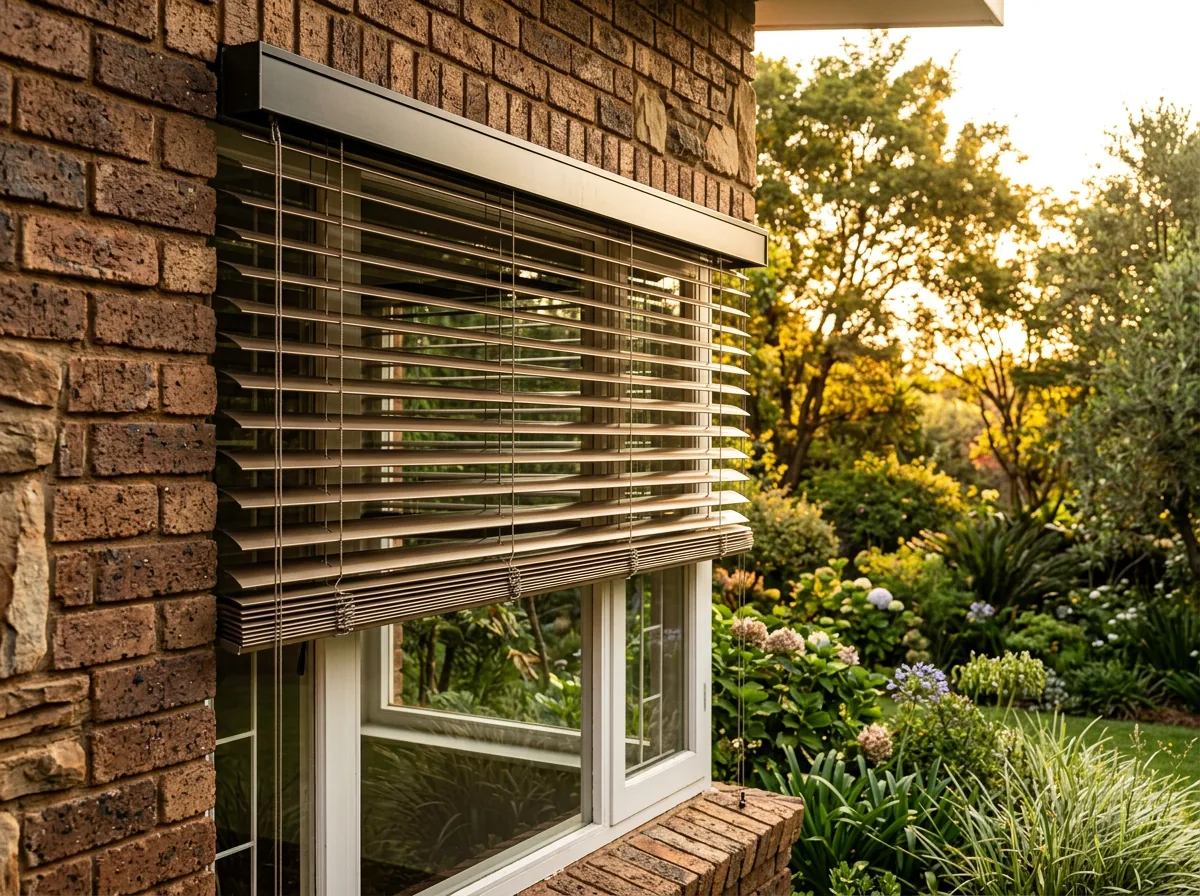
External venetian blinds mounted outside a west-facing face-brick Eldoraigne window, aluminium slats tilted to cut low afternoon sun

West elevation · our pick

External venetians

On a west wall the win is simple physics: stop the heat before it crosses the glass. External venetians sit outside the pane and reflect the afternoon load away, so the room stays cooler than it ever will with a blind inside — an interior blind darkens the room, but the sun-struck glass still radiates its absorbed heat inward. And unlike a solid roller shutter, the slats still tilt, so you keep daylight and the garden view.

The honest trade-off: exterior systems cost more than an interior blind, and in a security estate their colour and profile usually need sign-off. Where the west glass is small, or a body corporate is strict, a good interior blockout roller is cheaper, protects furnishings from fade and stays invisible from the street — sometimes the smarter call.

Prefer a solid exterior? Roller shutters do the same job with full blackout and a physical face over the glass for hail season — these are shading shutters, not security-rated ones.
North & garden-view glass · our pick

Sunscreen roller blinds

On the north-facing living glass that looks over Eldoraigne's mature gardens, a sunscreen roller keeps the view while cutting glare and the Highveld's fierce UV — a single smooth fabric sheet on a tube, no folds, at the usual 3–5% openness sweet spot. It filters the light rather than blocking it, so the leafy outlook people move here for stays part of the room.

The honest trade-off: sunscreen turns see-through at night once the lights are on, so it gives you daytime glare control but not evening privacy. In a room used after dark, pair it with a blockout roller on a double bracket — one fabric for day, one for night.

East bedrooms · our pick

Blockout roller blinds

East windows take a low, sharp sunrise straight onto the pillow. In a bedroom the honest answer is a blockout roller — a dense single fabric on a tube that genuinely darkens the room for a proper sleep-in, and holds winter warmth against that early chill. It's the simplest, most cost-effective fix for a room that lights up at dawn.

The honest trade-off: a blockout is all-or-nothing — up for light, down for dark, with no daytime middle setting. If you want privacy-with-a-bit-of-view during the day as well as a night block, a day/night (zebra) blind gives you both from one blind, at a little more cost and complexity.
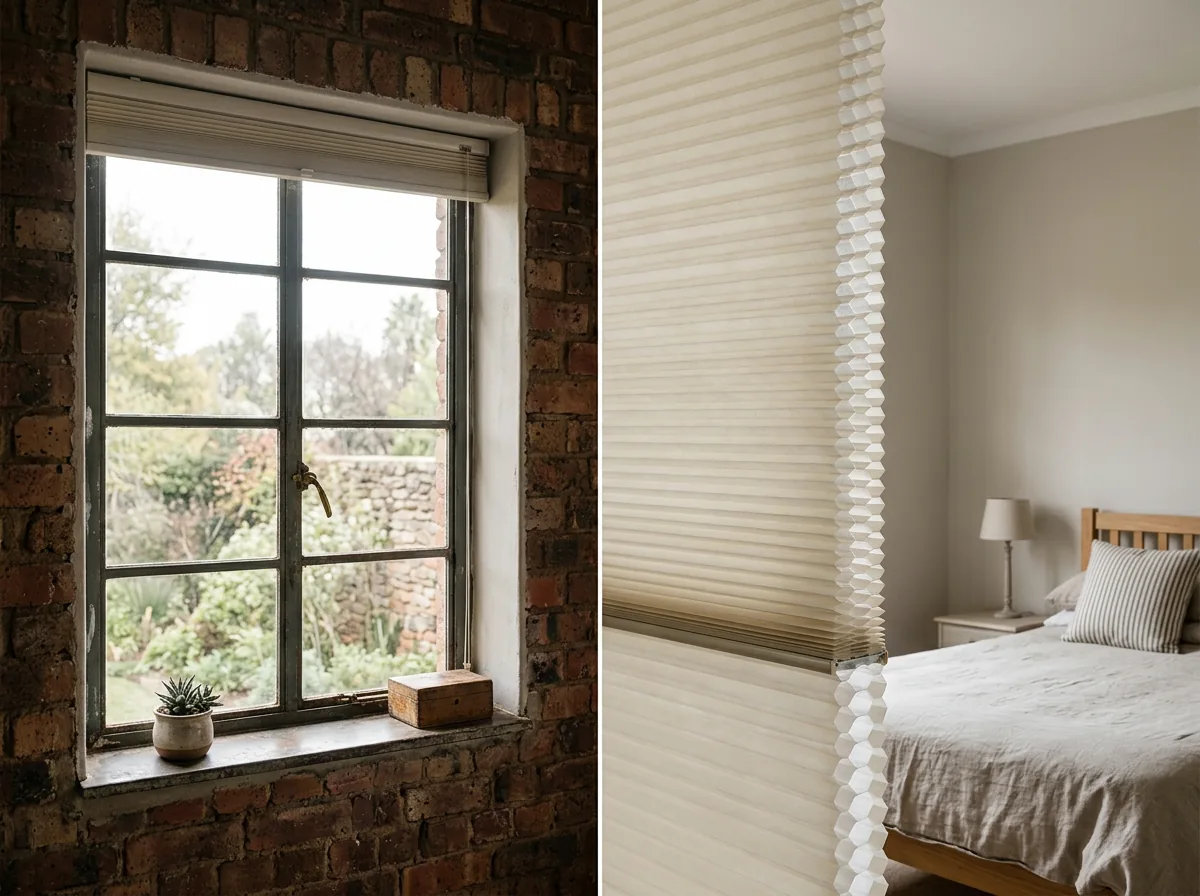
A cellular honeycomb blind lowered inside the deep reveal of an older single-glazed steel-framed Eldoraigne bedroom window, hexagonal cells visible at the edge

Cold single-glazing · our pick

Cellular / honeycomb blinds

Eldoraigne's older homes are almost all single-glazed, and Highveld winter nights are properly cold. A cellular blind traps a layer of air in its honeycomb cells right against the glass — the most insulating blind we fit — taking the edge off both the winter cold and the summer heat through that thin old pane, and it stacks away small on a shallow reveal.

The honest trade-off: a cellular blind raises and lowers but it cannot tilt, so it gives you privacy-or-view, not the in-between a venetian offers. If you like watching the garden through half-tilted slats, that flat cell face will feel like a compromise — the gain here is comfort and quiet, not adjustability.
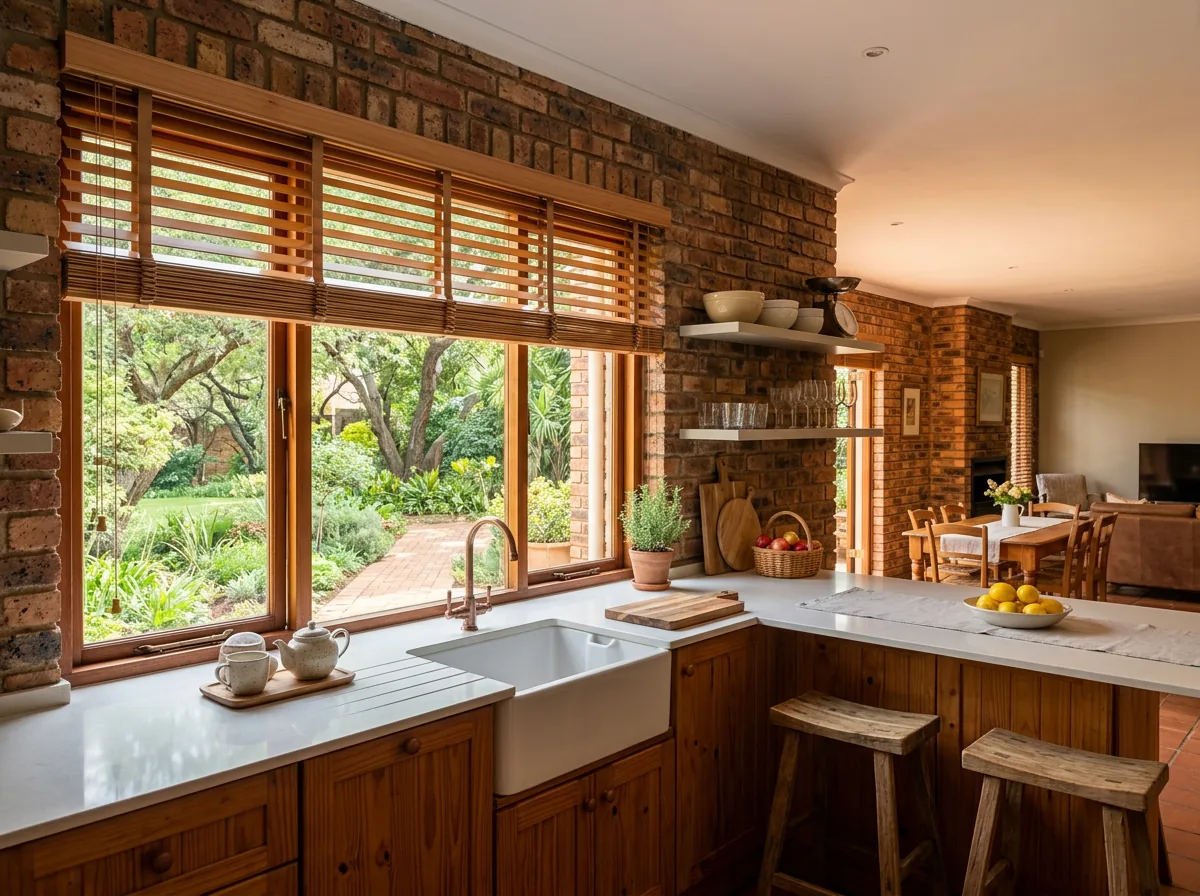
Timber venetian blinds tilted open at an open-plan kitchen window in an older face-brick Eldoraigne home, established garden beyond

Character rooms & kitchens · our pick

Timber venetian blinds

In a living room, study or open-plan kitchen where the face-brick warmth matters, a timber venetian steers light instead of just blocking it — tilt up for glare-free daylight, down for privacy — and warm basswood slats sit at home against brick and older joinery, working with the character of the room rather than hiding the window behind a flat panel.

The honest trade-off: timber slats gather dust and can bow in a steamy room over a few wet Highveld summers. Where there's real moisture — the kitchen sink window, a bathroom, a laundry — an aluminium venetian gives you the same tilt control but wipes clean and never warps. Choose timber for warmth, aluminium for the wet rooms.
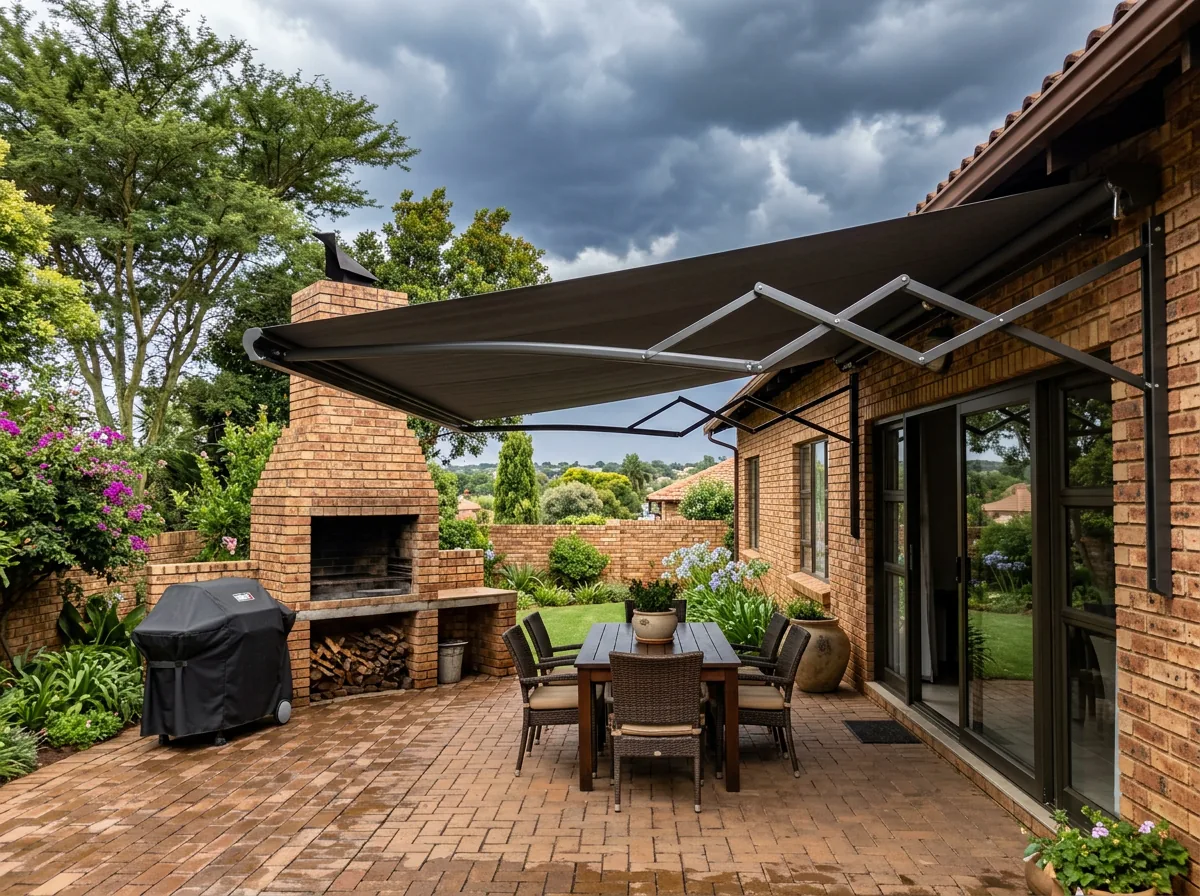
A folding-arm awning fully extended over a braai patio at a face-brick Eldoraigne home, no support posts, storm clouds building beyond the mature garden

The braai patio · our pick

Folding-arm awning

To shade a patio or braai area without building a permanent roof, a folding-arm awning extends a fabric canopy on articulated arms — no posts, no structure, and gone at the touch of a button when the low winter sun is exactly what you want on the paving. It gives you the shade of a roof only when you need it.

The honest trade-off: because it is fabric on an exposed Highveld elevation, it must be motorised with a wind sensor so it retracts before the afternoon storm — an un-sensored awning is the one that ends up wind- and hail-damaged. If you want permanent, walk-away cover, a fixed structure or a zip screen enclosure is more robust, if less flexible.

Wide sliding doors & rear extensions · our pick

Vertical / panel blinds & motorisation

Where an older Eldoraigne home has been extended at the rear with wide stacking or sliding doors, one narrow blind won't do it. Vertical or panel blinds tilt for light and draw fully clear of the glass, so you keep the whole opening; and on a wide or high span motorisation is often the only practical control — one remote or app for the elevation, and it removes cords entirely, the safest child-safe setup.

The honest trade-off: a wired motor is tidiest but wants deciding at renovation stage, while the walls are open; retrofitting cable through a finished ceiling is disruptive. If the extension is already closed up, battery motors are the clean way in, at the price of the occasional recharge.

Two ways down from here

Want this mapped to your own windows?

Send us the rooms that are bothering you and we'll do it properly — free, on site. Or pop in rough sizes first for a ballpark. Both live below.

Take me to the two ways forward

Estates & older frames

Two very different rulebooks on one street.

In the older part of Eldoraigne, the rulebook is the building itself. Original steel-framed casement windows sit in deep brick reveals that are rarely square and rarely a standard size. How far the glass sits back from the wall decides whether a blind mounts neatly inside the recess or face-fits onto the wall — and on a deep reveal, an outside mount often looks tidier and makes the window feel larger. That's measured window by window, never assumed.

In the newer security-estate pockets — Eldoglen, Eldo View and the like, plus the estates across the surrounding Centurion belt — anything visible from outside usually needs to satisfy an estate or body-corporate guideline on approved exterior colours and profiles. We specify exterior products in clean profiles and estate-appropriate colours, and can supply the product documentation most committees ask for at submission stage, so an approval isn't held up over a datasheet.

The honest bit

What a guide can't settle — and a measure can.

This is why the free in-home measure exists. These five things change the specification, and none of them can be judged from a page.

01

The exact reveal depth, window by window

Whether each casement mounts inside its deep brick recess or face-fits onto the wall — and on Eldoraigne's older openings it varies from one window to the next.

02

What the existing fixings and frames will hold

Fixing into original steel frames, plastered brick and older lintels is a look-and-tap job on site — not something judged from a page.

03

The true wind exposure of the patio

How open your braai patio is to the Highveld's afternoon gusts decides the awning cassette and the wind-sensor spec — an exposed corner is a different brief to a sheltered one.

04

Where the motor power actually runs

On a wide rear extension or a double-volume, whether we route wired power or fit battery motors depends on the cabling and the ceiling — decided on site.

05

Your estate's specific colour & profile rules

Each estate or body corporate asks for different documentation and finishes; we confirm exactly what your scheme wants before quoting anything visible from outside.

Two ways forward

The free measure — or a ballpark first.

Real per-window pricing comes from an in-home measure. If you'd rather see rough numbers before anyone visits, the ballpark tool does that too. Either is free, and neither commits you to anything.

The main way

Book your free expert measure

One visit covers every window and elevation: a consultant arrives with samples, measures precisely, advises on fabric, openness and motorisation for each room's light, and leaves you a written per-window quote — no obligation, no pressure.

Our consultant does five to six measures a week across Eldoraigne and the Centurion suburbs around it, so the diary fills early — worth booking ahead if you need a particular day.

We use these details only to arrange your consultation call-back (POPIA). No marketing lists, no sharing.

Or, a ballpark first

Your ballpark, in about two minutes

Want a ballpark first? Pop in rough sizes and we'll send a budget range by the next working day. Not sure how to measure? Leave it blank — our consultant measures for free and you'll get exact per-window pricing.

Eldoraigne Blinds — window worksheet

Walk the house, jot each window, then type it in later. Widths and drops in millimetres.

RoomWidthDropMountProduct

No photos needed here — if a picture would help, a consultant will simply ask in the reply. Your sizes are used only to prepare your budget range (POPIA).

Sources

Where the facts in this guide come from.

Every climate, sun-path and suburb claim above is drawn from the references below. Anything we couldn't verify to a specific source — a gazetted heritage boundary, an exact founding year for Eldoraigne — we've deliberately not asserted.

  1. Eldoraigne location, coordinates (≈25°50′30″S 28°09′33″E), population & character — Wikipedia: en.wikipedia.org/wiki/Eldoraigne
  2. Eldoraigne housing stock ("older but up-market", large stands, established leafy trees, security-estate pockets) — Private Property area guide: privateproperty.co.za
  3. Centurion altitude (≈1,432 m) & coordinates — CountryCoordinate: countrycoordinate.com; latitude.to
  4. Building orientation for South Africa (north / west / east elevations, "west-facing windows get hot afternoon sun") — Architecture South Africa: architecturesa.co.za; corroborated by Meik Architects "Why North?": meik.co.za
  5. High-altitude UV (≈10–12% rise per 1,000 m) — Delta Health: deltahealthco.org; Spot My UV: spotmyuv.com
  6. Highveld thunderstorm & hail season (Oct–Mar, peak November, afternoon 3–6pm) — Highveld storms briefing: flightlineweekly.com; Gauteng supercell study, Univ. of Pretoria: repository.up.ac.za; SA hail-hazard study (NHESS): nhess.copernicus.org
  7. Summer/winter noon sun elevation (≈87° / ≈41°) — calculated from the verified latitude (25.8°S) using standard solar declination (±23.44°), not asserted from a single page.